
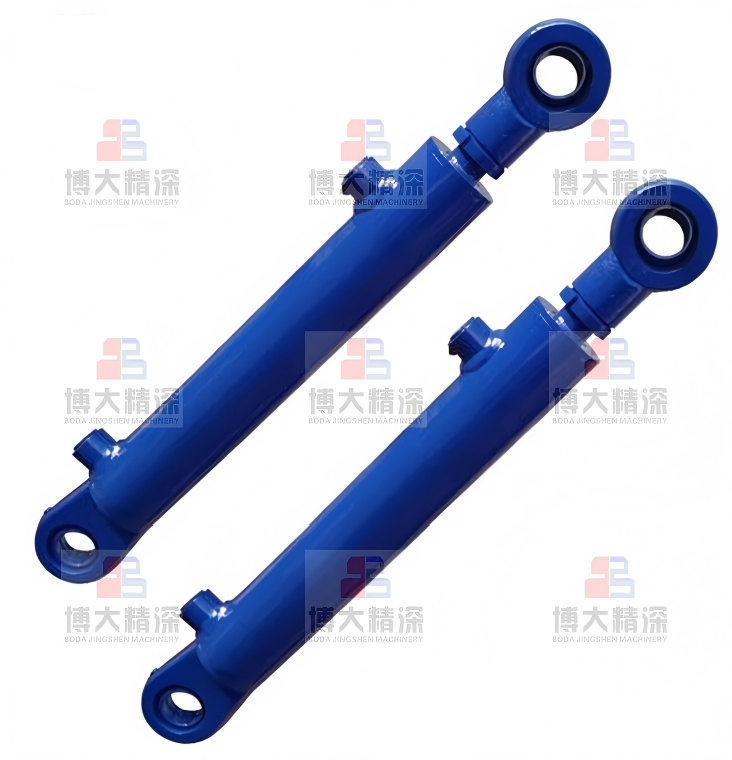
To understand the role of hydraulic cylinders in mine crushers, it is essential to first grasp the basic working principle of hydraulic systems in these machines. Most modern mine crushers—including jaw crushers, cone crushers, impact crushers, and gyratory crushers—adopt hydraulic systems as their core power transmission and control mechanism. Hydraulic systems utilize pressurized hydraulic fluid (typically mineral oil) to transmit power, offering advantages such as high power density, smooth operation, precise control, and overload protection. Hydraulic cylinders serve as the "executive organ" of these systems, translating the pressure energy of hydraulic fluid into linear mechanical motion (extension or retraction), which drives the movement of key crusher components. Unlike mechanical transmission, hydraulic cylinders can deliver large forces with compact structures, making them ideal for the heavy-duty, high-load requirements of mine crushers.
The primary role of hydraulic cylinders in mine crushers is to provide the necessary linear force and motion to drive critical operational processes, ensuring the crusher can efficiently break down ore and rock. The specific functions of hydraulic cylinders vary depending on the type of crusher, but they all revolve around controlling the crushing process, adjusting operational parameters, and protecting the equipment from damage. From adjusting the discharge gap to activating safety mechanisms, hydraulic cylinders are involved in almost every core operation of a modern mine crusher, making them indispensable to the machine’s functionality.
One of the most fundamental functions of hydraulic cylinders in mine crushers is adjusting the discharge gap. The discharge gap— the distance between the crushing surfaces (e.g., jaw plates in jaw crushers, cone liners in cone crushers)—directly determines the size of the crushed product. To meet different processing requirements (e.g., producing coarse, medium, or fine aggregates), the discharge gap must be adjustable. Hydraulic cylinders enable precise and convenient adjustment of this gap: when the cylinder extends or retracts, it drives the movable crushing component (e.g., the movable jaw in jaw crushers, the mantle in cone crushers) to move, changing the distance between the fixed and movable crushing surfaces. This adjustment can be performed either during machine operation (for continuous production adjustment) or during shutdown (for major parameter changes), ensuring the crusher can adapt to varying ore types and processing needs. For example, in jaw crushers, a hydraulic cylinder is typically connected to the movable jaw, allowing operators to fine-tune the discharge gap to achieve the desired product size, thereby improving the crusher’s versatility and product quality.
Hydraulic cylinders also play a crucial role in the overload protection of mine crushers. Mining operations often involve unpredictable feed materials, including uncrushable objects (e.g., metal debris, large hard rock chunks) that can enter the crushing chamber. If these objects are not promptly removed, they can cause severe damage to the crusher’s components—such as jamming the crushing chamber, bending the main shaft, or wearing the crushing plates. Hydraulic cylinders provide a reliable overload protection mechanism: when an uncrushable object enters the chamber, the pressure in the hydraulic system rises sharply beyond the preset limit. This triggers the hydraulic cylinder to retract automatically, opening the crushing chamber and allowing the uncrushable object to fall out. Once the object is removed, the hydraulic cylinder extends back to its original position, and the crusher resumes normal operation. This function not only protects the crusher from costly damage but also minimizes downtime, as operators do not need to manually disassemble the machine to clear jams.
In cone crushers and gyratory crushers, hydraulic cylinders perform an additional critical function: maintaining the crushing pressure. These types of crushers rely on a constant, high pressure between the mantle (movable component) and the concave (fixed component) to crush ore effectively. Hydraulic cylinders apply and maintain this pressure by exerting a continuous force on the mantle, ensuring that the ore is crushed to the desired size with consistent efficiency. The hydraulic system, with the help of hydraulic cylinders, can automatically adjust the pressure based on the hardness and size of the ore, optimizing the crushing process and reducing energy consumption. For example, when processing harder ore, the hydraulic cylinder increases the pressure to ensure effective crushing, while for softer ore, it reduces the pressure to save energy and reduce wear on the crushing components.
Hydraulic cylinders are also essential for the emergency stop and maintenance of mine crushers. In the event of an emergency (e.g., equipment failure, power outage, or safety hazard), hydraulic cylinders can quickly retract to open the crushing chamber, allowing operators to safely shut down the machine and address the issue. During maintenance, hydraulic cylinders can be used to retract or position key components (e.g., movable jaw, mantle) to provide access to internal parts of the crusher, simplifying maintenance tasks and reducing maintenance time. For example, when replacing the crushing plates in a jaw crusher, the hydraulic cylinder retracts the movable jaw, creating sufficient space for operators to remove and install new plates, improving maintenance efficiency and safety.
Another important function of hydraulic cylinders in mine crushers is absorbing impact forces. Mine crushers generate significant impact forces during operation, especially impact crushers and jaw crushers, which rely on high-impact blows to break ore. These impact forces can cause vibration and stress on the crusher’s frame and components, leading to wear and tear over time. Hydraulic cylinders, with their inherent damping characteristics, can absorb and dissipate these impact forces, reducing vibration and protecting the crusher’s structure. The hydraulic fluid in the cylinder acts as a buffer, absorbing the energy of the impact and reducing the stress transmitted to the frame and other components. This not only extends the service life of the crusher but also improves operational stability, reducing the risk of component failure.
In addition to their core functions, hydraulic cylinders contribute to the overall efficiency and performance of mine crushers. Due to their high power density, hydraulic cylinders can deliver large forces with compact structures, allowing crushers to be designed with smaller footprints—an important advantage in mining sites where space is often limited. Hydraulic cylinders also offer smooth and precise motion control, ensuring consistent operation and uniform product size. Unlike mechanical actuators, hydraulic cylinders can operate at variable speeds, allowing operators to adjust the crushing process based on real-time conditions, further optimizing efficiency. Additionally, hydraulic systems (including cylinders) require less maintenance compared to mechanical transmission systems, reducing operational costs and downtime.
Different types of hydraulic cylinders are used in mine crushers, each designed to meet specific operational requirements. The most common types include single-acting cylinders and double-acting cylinders. Single-acting cylinders are used in applications where force is only required in one direction (e.g., adjusting the discharge gap in some jaw crushers), relying on gravity or a spring to retract. Double-acting cylinders, which can exert force in both extension and retraction directions, are widely used in cone crushers, impact crushers, and modern jaw crushers, as they provide more flexible and precise control. Hydraulic cylinders used in mine crushers are typically made of high-strength steel to withstand high pressures and harsh environments, with corrosion-resistant coatings to protect against dust, moisture, and chemical exposure.
Proper installation, maintenance, and inspection of hydraulic cylinders are essential to ensure their reliable operation. Hydraulic cylinders must be installed correctly to ensure alignment with the crusher’s components, preventing uneven wear and stress. Regular maintenance includes checking for hydraulic fluid leaks, inspecting the cylinder rod for damage (e.g., scratches, corrosion), and ensuring the seals are intact. The hydraulic fluid must be regularly filtered and replaced to prevent contamination, which can cause damage to the cylinder and other hydraulic components. Additionally, operators should monitor the pressure and performance of hydraulic cylinders to detect potential issues early, avoiding costly breakdowns and downtime.
In conclusion, hydraulic cylinders are a critical component of modern mine crushers, serving multiple vital functions that ensure the machine’s efficient, safe, and reliable operation. From adjusting the discharge gap and providing overload protection to maintaining crushing pressure, absorbing impact forces, and facilitating maintenance, hydraulic cylinders are integral to every aspect of the crusher’s performance. In the harsh and demanding environment of mining operations, where reliability and efficiency are paramount, hydraulic cylinders play an indispensable role in reducing downtime, protecting equipment, and optimizing productivity. By understanding their role and functions, mining companies can ensure that their crushers operate at peak performance, reduce operational costs, and achieve long-term operational success.