
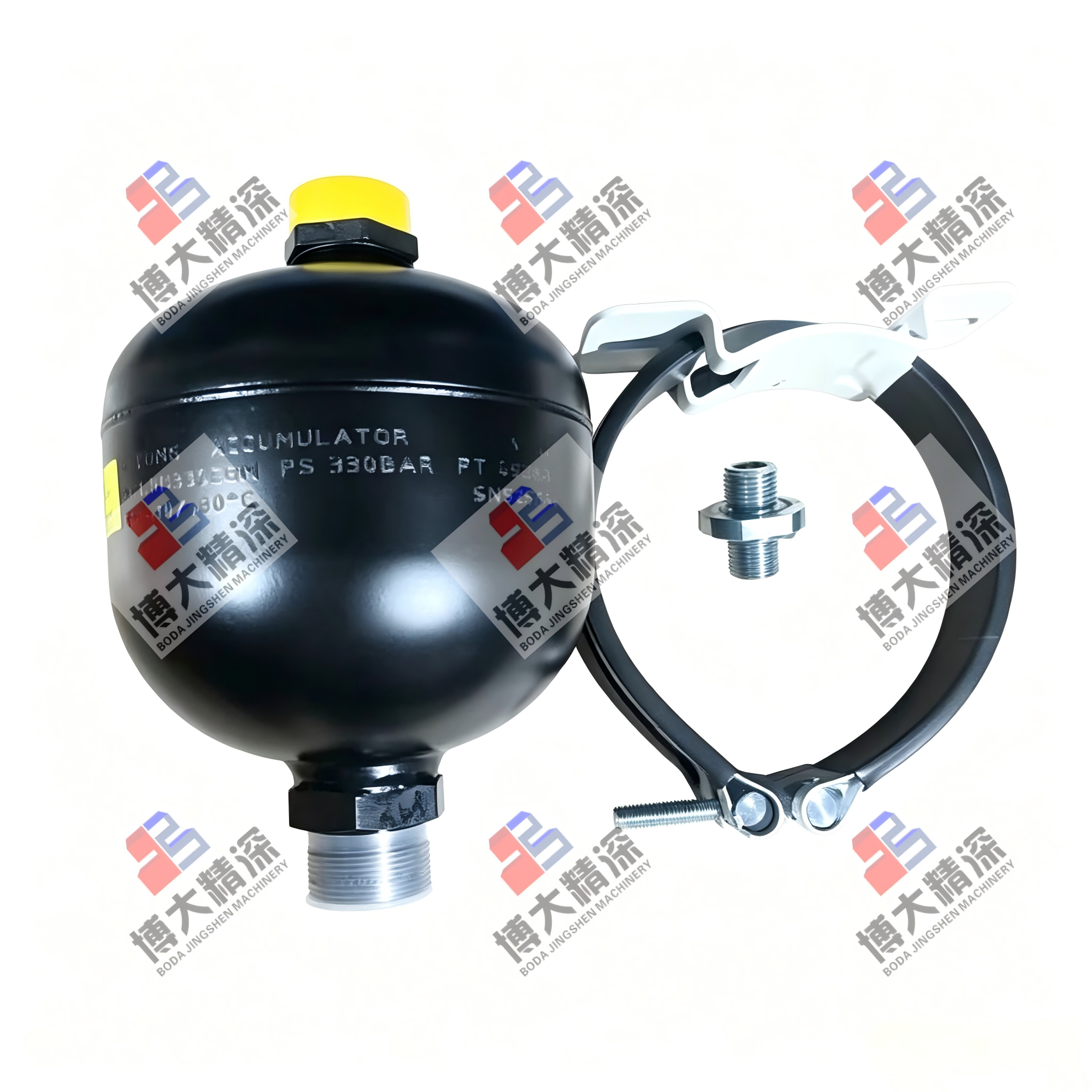
The bladder-type hydraulic accumulator displayed in the picture is a critical pressure-storing hydraulic component extensively installed on cone crushers, the mainstream crushing equipment for hard-rock mining operations. This pressure-rated unit carries a maximum working pressure of 330 bar, engineered to withstand the intense cyclic hydraulic pressure spikes generated during ore crushing cycles. Outfitted with a dedicated mounting clamp and threaded pipe fitting for field assembly, the accumulator relies on pre-charged compressed inert nitrogen gas inside its internal rubber bladder to store and release hydraulic pressure dynamically. Integrated into the crusher’s hydraulic relief and lubrication loop, it undertakes shock load buffering, instantaneous pressure supply, hydraulic overload protection, pressure leakage compensation and extended component service life within harsh quarry and underground mining operating environments. Without properly calibrated accumulators, cone crushers face drastically elevated risks of catastrophic shaft fracture, hydraulic pipe rupture, liner breakage and extended unplanned production downtime.
The foremost core function of the crusher accumulator is overload protection against uncrushable foreign debris trapped inside the crushing cavity, the most mission-critical safety duty for cone crusher hydraulic systems. During continuous mineral processing, stray steel drill bits, broken rail scraps, oversized rock boulders and reinforced concrete fragments frequently slip into the crushing chamber. These objects possess compressive strength far above the design threshold of manganese steel crushing liners. When hard foreign matter clogs the mantle and concave liner gap, instantaneous hydraulic pressure inside the crusher’s release cylinder surges far past standard operating levels. The pre-pressurized nitrogen bladder inside the accumulator compresses automatically to accept surplus hydraulic oil volume when line pressure spikes sharply. This controlled volume absorption permits the crusher’s adjustment sleeve to lift upward, widening the crushing gap to discharge trapped obstructions rapidly. Once blockages clear and system pressure drops back to the baseline operating range, compressed nitrogen expands to push stored hydraulic fluid back into the circuit, resetting the crushing sleeve to the preset working clearance. This passive pressure-response mechanism prevents destructive peak stress from cracking the main shaft, snapping the locking bolt assembly or bursting high-pressure hydraulic tubing, replacing outdated unreliable metal spring overload protection fitted on legacy cone crusher models.
Second, the accumulator dampens cyclic pressure vibration and mechanical shock stemming from repeated rock crushing impacts. Each time hard ore is squeezed and fractured between cone liners, sharp pulsed hydraulic load transfers to the closed hydraulic circuit. Unmitigated recurring pressure surges induce hydraulic line resonance, accelerated seal fatigue, threaded joint loosening and gradual cast-metal frame cracking over long operating cycles. The elastic compression and rebound motion of the internal bladder absorbs transient pressure spikes, smoothing volatile hydraulic pressure fluctuations into a steady baseline pressure reading across the whole hydraulic network. Suppressed hydraulic vibration further reduces mechanical shock transmitted to the crusher’s main bearing assembly, cutting abrasive wear on precision rolling bearing raceways and lowering metal fatigue risk on high-load structural castings. For mines running crushers 24 hours per day in continuous shift schedules, effective vibration attenuation from accumulators can prolong main bearing service tenure by 30 to 45 percent, slashing recurring expensive bearing replacement expenses and maintenance downtime.
Third, the accumulator serves as a standby instantaneous hydraulic power reserve for fast gap adjustment and emergency pressure maintenance. Operators modify crusher output ore grading by raising or lowering the upper adjustment sleeve to alter liner clearance. When rapid sleeve repositioning is required during production grade switching, the accumulator expels pre-stored pressurized hydraulic oil instantly, delivering high flow rates far quicker than the output limit of the compact on-board manual hydraulic pump unit. Swift clearance tuning shortens grade-change downtime from multiple minutes down to mere seconds, boosting overall hourly crushing throughput. In the event of brief primary hydraulic pump malfunction or minor circuit leakage, pressurized fluid retained inside the accumulator sustains baseline system pressure temporarily. This buffer window grants maintenance staff time to execute planned pump repairs without triggering an immediate full crusher system shutdown and emergency ore feed halts.
Fourth, the unit compensates for gradual minor hydraulic fluid leakage across sealed joints, dynamic shaft seals and threaded pipe connections inherent to long-duration mining operation. Slow pressure bleed-down over weeks of runtime would steadily reduce overload protection responsiveness without supplementary pressure replenishment. Gas-driven fluid discharge from the accumulator offsets lost internal volume, holding circuit pressure locked within the manufacturer-specified tolerance band. Stable calibrated pressure guarantees the overload relief trigger threshold stays consistent; improperly low pre-charge pressure would cause premature sleeve lift during routine crushing cycles, yielding undesirably coarse finished aggregate and unstable product particle grading that fails construction aggregate industry specifications.
Robust construction of this mining-grade accumulator adapts reliably to rugged site conditions. Its thick carbon steel outer shell with anti-corrosion black paint resists abrasion from airborne silica mineral dust, humidity inside underground mines and incidental corrosive slurry splatter. The rated operating temperature window of -10 °C to 80 °C maintains dependable bladder elasticity across frigid winter open-pit quarry shifts and high-temperature summer enclosed crushing shed operation. The included metal mounting clamp secures the pressure vessel rigidly to the crusher frame, eliminating resonant rattling that would loosen threaded port connections.
From comprehensive operational cost analysis, accumulator deployment delivers measurable long-term financial savings for mineral processing sites. It curtails costly catastrophic component replacement for main shafts, premium roller bearings and cast frame segments damaged by unbuffered overload shocks. Stabilized particle grading reduces rejected out-of-spec aggregate waste that would otherwise need re-crushing reprocessing. Sustained uptime from shortened grade adjustment intervals and emergency fault buffer capacity lifts total daily ore tonnage output for mining operations. Routine servicing work only requires periodic nitrogen pre-charge top-ups during scheduled crusher overhaul windows, carrying negligible recurring maintenance labor and material outlay.
To conclude, the bladder-type hydraulic accumulator functions as the foundational safety and pressure-regulation hardware integrated into cone crusher hydraulic assemblies. It executes automatic overload debris relief, hydraulic shock suppression, standby rapid hydraulic power delivery and steady leakage compensation, resolving multiple failure-prone pain points inherent to high-load hard-rock crushing workflows. Correct pre-charge calibration and periodic inspection of these accumulators underpin steady product quality, lower unplanned breakdown frequency, extended service lifespan of high-value crusher core parts, and improved overall profit margins for both small-scale quarry operators and large industrial mineral extraction enterprises.